Daigo Tomono
July 26, 2002
 change by the micro-lens to be integrated into the
spectrograph entrance slit is considered.
From paraxial
calculations, the effective A depends upon
distance
change by the micro-lens to be integrated into the
spectrograph entrance slit is considered.
From paraxial
calculations, the effective A depends upon
distance  between the fiber exit and the micro-lens. A
change is minimum with
between the fiber exit and the micro-lens. A
change is minimum with
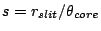 when
when  is
radius of the imaged slit and
is
radius of the imaged slit and  is the light cone angle
of the light from
the fiber measured in the air. In the case, the effective A becomes
is the light cone angle
of the light from
the fiber measured in the air. In the case, the effective A becomes
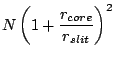
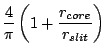
 times larger.
For the smallest A, focal length of the micro lens is
 with numerical aperture of light
  (with
(with
 )
and pseudo slit width
)
and pseudo slit width  (with
(with
 ). If the
lens is directly attached to the fiber exit, its length should be
). If the
lens is directly attached to the fiber exit, its length should be
 and surface
curvature radius be
and surface
curvature radius be
 . Moreover, lens
radius is
. Moreover, lens
radius is
 and focal
ratio is
and focal
ratio is
![$F = 1/[2\arcsin N\!A \times (D_{core}/w_{slit} - 1)]$](img20.png) .
.
Postscript version of this report is also available: slitlens.ps.gz.
enlarged by the sparse core area surrounded by
the cladding layers in the pseudo
slit. Table 1 shows an example of the K-band spectrometer.
The design assumes 50  m diameter fiber cores and 100 m
interval to align the fibers, and the 100 m interval is imaged on 2
pixels of the FPA. As this is a paraxial calculation, lens diameter of
the camera optics is practically larger than 290 mm, which is too big to
be really constructed.
m diameter fiber cores and 100 m
interval to align the fibers, and the 100 m interval is imaged on 2
pixels of the FPA. As this is a paraxial calculation, lens diameter of
the camera optics is practically larger than 290 mm, which is too big to
be really constructed.
A micro-lens array on the spectrometer entrance slit is considered here
to minmize the A required for the spectrometer.
| fiber FOV | 0.2 arcsec |
| N.A. of light | two times bigger to allow FRD |
| fiber core diameter | 50 m |
| fiber cladding diameter | 100 m |
| resolution power | 4000 |
| grating diffraction order | 2 |
| groove interval | 12.6 m |
| central wavelength | 2.2 m |
| width of a spectral element on FPA | 37 m |
incident angle  |
-4.6 deg |
emergent angle  |
25.4 deg |
| collimator focal length | 1035 mm |
| camera focal length | 382 mm |
| incident beam width | 321 mm |
| grating width | 322 mm |
| emergent beam width | 290 mm |
 in m, with the
scrambled telescope pupil is imaged on the exit. The micro-lens images
the scrambled telescope focal plane onto an image plane of radius
in m, which is the assumed cladding diameter. The
paraxial micro-lens is assumed to be placed (in m) from the fiber
exit, making the image plane
in m, with the
scrambled telescope pupil is imaged on the exit. The micro-lens images
the scrambled telescope focal plane onto an image plane of radius
in m, which is the assumed cladding diameter. The
paraxial micro-lens is assumed to be placed (in m) from the fiber
exit, making the image plane  (in m) from the lens. Here, effective
focal length of the micro-lens
(in m) from the lens. Here, effective
focal length of the micro-lens  is the same as .
of a ray
in the air. Output light cone angle is calculated as
follows for small  .
.
As a collimated beam is focused onto a single point on the image plane,
can be calculated as
 is calculated tracing light
from upper most point and lower most point on the fiber core going in to
the lens in the same
direction as the optical axis:
is calculated tracing light
from upper most point and lower most point on the fiber core going in to
the lens in the same
direction as the optical axis:
 |
(2) |
at the slit for a collimated beam is
 |
 |
 |
(3) |
|
 |
(4) |
of a ray on the fiber eixt is the same as on the pseudo
slit.
 of the light depends upon the direction of light from
the fiber core.
of the light depends upon the direction of light from
the fiber core.
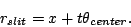
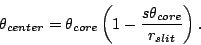
A ray from the center with maximum divergence from the optical axis goes
through the lens at
 |
(5) |
 |
(6) |
 |
(7) |
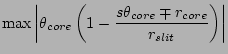
 from the image plane is
 |
|
 |
(8) |
|
 |
(9) | |
|
 |
(10) |
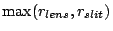
 determines the slit length when it is
bigger than the cladding size and the image size .
From geometry,
determines the slit length when it is
bigger than the cladding size and the image size .
From geometry,
 is defined as
of the light from the slit imaged by the micro-lens
is calculated from and . Change factor  of
A at the fiber output (A
of
A at the fiber output (A ) and at the slit
(A
) and at the slit
(A ) is defined and calculated as follows:
 |
 |
 |
(14) |
|
 |
(15) | |
|
 |
(16) |
 |
|
 |
(17) |
 |
|
 |
(18) |
Figure 3 shows the three functions. has two minima at
=  and
and  with the values of
 |
(19) |
is smaller than for our purpose, minimum
value of is at . Therefore, our micro-lens should be designed
so that
.
also depends upon the number
of fibers we have to handle.
When  fibers with core radius and emergent light cone
angle of are considered, simple sum of A of the
light is
fibers with core radius and emergent light cone
angle of are considered, simple sum of A of the
light is
 |
(21) |
First the fibers with cladding radius  are considered to be
simply lined up on the slit. In the case, we have to extend the
acceptance field of view of the spectrograph. With an on-axis system,
the field of view have to be a circular with a radius of
are considered to be
simply lined up on the slit. In the case, we have to extend the
acceptance field of view of the spectrograph. With an on-axis system,
the field of view have to be a circular with a radius of
 . In the case effective A of the light that the
spectrograph has to accept is
. In the case effective A of the light that the
spectrograph has to accept is
 |
(22) |
by . In the case effective
A is
 |
(23) |
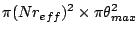
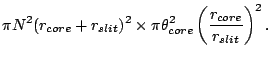
With a micro lens array with
, effective
A of the circular field of view becomes
 |
|
 |
(24) |
|
 |
(25) |
 |
|
 |
(26) |
|
 |
(27) |
 changes of effective A are
calculated as in Table 2.
changes of effective A are
calculated as in Table 2.
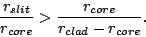
It is better to integrate a micro lens array on the
spectrograph entrance slit if the pesudo slit can be wide enough:
 |
(28) |
 and
and
 , should be
 if we are to
integrate a micro lens array.
if we are to
integrate a micro lens array.
(
 times bigger than the input light)
when
. From Equation 1,
times bigger than the input light)
when
. From Equation 1,
 . Therefore, to minimize effective A,
  in Figures 1 and 2.
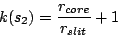
From geometry, focal length of the micro lens is the same as ,
and defined by
is the light cone angle of light in the air
with numerical aperture we have to accept in the slit width
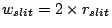 .
.
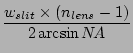
We are thinking of micro lens directly attached to the fiber exit. In the
case, lens length  has to be made longer from according to
its refractive index
has to be made longer from according to
its refractive index  . Therefore,
 |
|
 |
(31) |
|
 |
(32) |
 |
|
 |
(33) |
|
 |
(34) |
 |
|
 |
(35) |
|
 |
(36) |
 |
|
 |
(37) |
|
 |
(38) |
 .
.
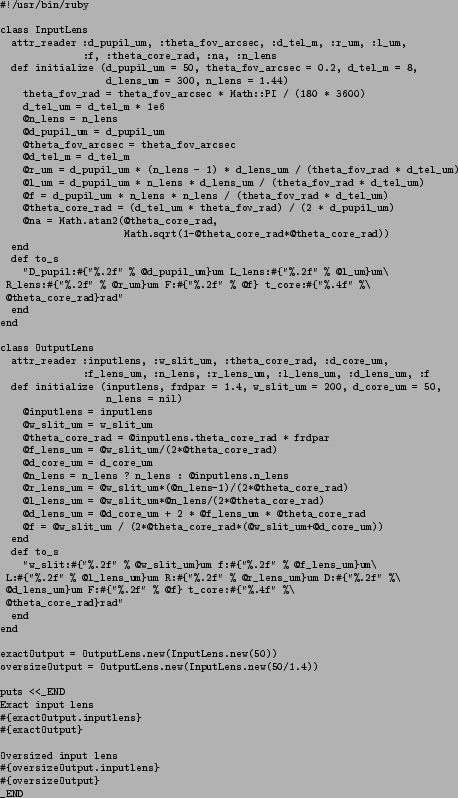
gin-an:tomono:~/Design02/0508_MicroLens/ with a ruby script shown
in Table 4. A zemax simulation for the design is
shown in Figure 4.
| Input micro-lens | |
Pupil image diameter  |
50/1.4 m |
Fiber FOV  |
0.2 arcsec |
Telescope diameter  |
8 m |
Lens diameter  |
300 m |
| Refractive index | 1.44 |
| Lens length | 1988.98 m |
| Curvature radius | 607.74 m |
| Focal ratio | 9.55 |
| Light cone angle | 0.1086 rad |
| Output micro-lens | |
| FRD parameter (output/input cone angle) | 1.4 |
| Pseudo slit width | 200 m |
| Fiber core diameter | 50 m |
| Refractive index | 1.44 |
| Lens length | 947.13 m |
| Curvature radius | 289.40 m |
| Lens diameter | 250 m |
| Focal ratio | 2.63 |
| Light cone angle | 0.1520 rad |
This document was generated using the LaTeX2HTML translator Version 2K.1beta (1.52)
Copyright © 1993, 1994, 1995, 1996,
Nikos Drakos,
Computer Based Learning Unit, University of Leeds.
Copyright © 1997, 1998, 1999,
Ross Moore,
Mathematics Department, Macquarie University, Sydney.
The command line arguments were:
latex2html -dir html -mkdir -image_type png -local_icons -split 0 -up_url .. -up_title 'Parent directry' slitlens.tex
The translation was initiated by Daigo Tomono on 2002-07-26

![\includegraphics[width=0.75\textwidth]{centerbeam.eps}](img33.png)
![\includegraphics[width=0.75\textwidth]{sidebeam.eps}](img43.png)



 ,
,
![\includegraphics[width=0.75\textwidth]{effaom.eps}](img66.png)




![\rotatebox{90}{\includegraphics[height=0.75\textwidth]{oversize.eps}}](img112.png)