


Daigo Tomono
February 4, 2002
 must be as small as possible.
 and emergent angle
  must be as
close as possible.
must be as
close as possible.
 must be as big as possible.
Secondary peaks beyond the first local minima has 4.7% peak intensity of the primary peak. This is not considered in efficiency calculation.
For the  -band, calculated efficiency is more than about 96%
throughout the band when
-band, calculated efficiency is more than about 96%
throughout the band when
 ,
,  , and
, and
 . With larger , efficiency increases. When and
are separated, efficiency drops to about 95% for 20 deg
difference.
. With larger , efficiency increases. When and
are separated, efficiency drops to about 95% for 20 deg
difference.
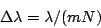
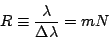
When the slit width is wider than a certain limit, namely, spatial
resolution of the instrument is less than the diffraction limit of the
telescope, spectral resolution of the spectrometer is limited by the
geometrical size of the slit. When the field of view (FOV) of a
spatial element is  of diffraction limited spatial elements, we
need about
of diffraction limited spatial elements, we
need about  times more grating grooves to achieve the same spectral
resolving power for a diffraction limited instrument.
times more grating grooves to achieve the same spectral
resolving power for a diffraction limited instrument.
Postscript version of this report is also available: grating.ps.gz.
Interferometry is calculated on a grating with groove interval and
groove angle  as in Figure 1.
 with signed angle comes
from distance
with signed angle comes
from distance  . Consider detecting emergent light with signed
angle at
. Consider detecting emergent light with signed
angle at
 distance
  . Here, light
reflected at the point
. Here, light
reflected at the point  is considered. Throughout this report,
refractive index of media around the grating is assumed to be 1.
is considered. Throughout this report,
refractive index of media around the grating is assumed to be 1.
Distance between  and
and  is
is
 and distance between and the coordinate origin is
 . So,
. So,  can be approximated as
 . Likewise
 .
Using the incident and emergent angles,
.
Using the incident and emergent angles,
 and
and
 . Therefore, light path going through can be
explained as
. Therefore, light path going through can be
explained as
 and
and
 .
.
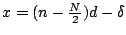
On the th groove of total  grooves,
 and
and
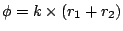
 . Therefore, phase delay
 at
at  of the light from and reflected at
is
of the light from and reflected at
is
 .
Here, we define
.
Here, we define
is
calculated from integration over the grating surface. Here we take the
shadowing effect into account. As shown in Figure 2, only
 of the groove surface reflects the light.
Normalizing at  and
and  , intensity of the light detected at
is
, intensity of the light detected at
is
 so
so
When the incident angle and diffraction order is known,
emergent angle can be calculated as
is an integer of the diffraction order.
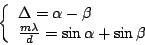
On the other hand, when we define difference of incident and emergent
angles,
and is calculated as follows with fixed :
or
 .
.
 can be treated as
instrumental profile when difference of incident light direction (half
width)
can be treated as
instrumental profile when difference of incident light direction (half
width)  is smaller than
![$\sim \lambda /
(2Nd\cos[\alpha_0])$](img80.png) where
where  is the center direction of the
incident light. In Figure 3, left-most curve shows
normalized profile of at
is the center direction of the
incident light. In Figure 3, left-most curve shows
normalized profile of at  and
and  .
Horizontal axis is change of
.
Horizontal axis is change of  from the center of the
spectra.
from the center of the
spectra.
 , spectral resolution of the grating is calculated as
follows. First, we have a peak at
, spectral resolution of the grating is calculated as
follows. First, we have a peak at
 for a
wavelength
for a
wavelength  . Near the peak, there are local minima at
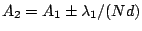 . We define spectral resolution when the next
spectral element of
. We define spectral resolution when the next
spectral element of  is at the local minima
  . Namely,
for the th order, we have a peak for at
. Namely,
for the th order, we have a peak for at
 . Thus, the wavelength difference
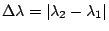 or
or
 that
makes
that
makes
![$\cos[kdNA'] = -1$](img96.png) beyond the first local minima. For the peak of
th order diffraction of
beyond the first local minima. For the peak of
th order diffraction of  ,
,
 .
The position corresponds to the peaks for
.
The position corresponds to the peaks for
 .
.
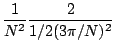
Near the secondary peaks, from , grating function is
 |
 |
![$\displaystyle \frac{1}{N^2} \frac{1-\cos[kdNA']}{1-\cos[kdA']}$](img101.png) |
(16) |
 |
![$\displaystyle \frac{1}{N^2} \frac{2}{1-\cos[3\pi/N]}$](img102.png) |
(17) | |
|
 |
(18) | |
|
 |
(19) |
 .
.
Exact positions of secondary peaks can be obtained by taking
differential of the grating function. Position and value of the peaks
weakly depends on . The secondary peaks are nearer to the primary
peak and has intensity about 4.7 % of the primary peak when is more
than about 1000.
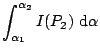
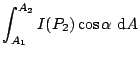
When the direction of the collimated light spreads from
 to
to
 ,
Equation 8 has to be integrated from
,
Equation 8 has to be integrated from  to
to
 and profile of the spectra can be assessed.
 .
We can assume
.
We can assume
 (slit width is
small, if not narrow) and
(slit width is
small, if not narrow) and  (the spectrometer is used around
the Bragg's condition). In the case,
(the spectrometer is used around
the Bragg's condition). In the case,
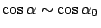 and
and
![$1-\cos[kd'E]\sim(kd'E)^2/2$](img119.png) .
When the grating is used in the th order, can be replaced with
.
When the grating is used in the th order, can be replaced with
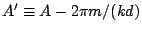 . Near the and of spectra we
are observing,
. Near the and of spectra we
are observing,  . Therefore,
![$1-\cos[kdA] = 1-\cos[kdA'] \sim
(kdA)^2/2$](img122.png) . Here, we define
. Here, we define
![$A'_{1,2} = A_{1,2} - 2\pi m/(kd) \sim \sin
\alpha_0 + \sin\beta - 2\pi m/kd \pm \cos[\alpha_0] \delta\alpha$](img123.png) and
the integration becomes
and
the integration becomes
 and
and
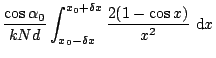
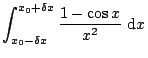
![$\delta x\equiv kNd\times\cos[\alpha_0] \delta\alpha$](img128.png) . The equation
cannot be integrated analytically.
. The equation
cannot be integrated analytically.
Figure 3 shows results from numerical integration of
Equation 26 with different  . For
smaller than
. For
smaller than  , width of the spectra is comparable with that
for
, width of the spectra is comparable with that
for  . On the other hand, for
 , the profile
gets half of the center at
, the profile
gets half of the center at
 .
.
![\includegraphics[width=0.8\textwidth]{nocoherent.eps}](img133.png)
|
From the definition,
 corresponds to a threshold
angular half width of the slit
corresponds to a threshold
angular half width of the slit
![\begin{displaymath}
\delta\alpha_{th} \sim \pi/(kNd\cos[\alpha_0]) =
\lambda/(2Nd\cos[\alpha_0]).
\end{displaymath}](img135.png) |
(26) |
 , spectral resolution of the
spectrometer is not limited by diffraction of the grating, but limited
by geometrical width of the slit.
, spectral resolution of the
spectrometer is not limited by diffraction of the grating, but limited
by geometrical width of the slit.

 ,
field of view (FOV) of a spatial element on a telescope with entrance
pupil diameter of
,
field of view (FOV) of a spatial element on a telescope with entrance
pupil diameter of  is in the order of
 .
Thus, the system becomes
.
Thus, the system becomes
 . On a
seeing limited instrument, FOV of a spatial element is more than for the
diffraction limited instrument. Here, we assume to observe FOV
times larger than that for a diffraction limited instrument. In the
case, system becomes
. On a
seeing limited instrument, FOV of a spatial element is more than for the
diffraction limited instrument. Here, we assume to observe FOV
times larger than that for a diffraction limited instrument. In the
case, system becomes
 .
.
When the diameter of the grating is  , beam width of incident
light becomes
, beam width of incident
light becomes
![$D_{gr}\cos[\alpha_0]$](img143.png) . Considering only about the beam in
the dispersion direction, solid angle of the light going into the
grating is
. Considering only about the beam in
the dispersion direction, solid angle of the light going into the
grating is
![$\Omega_{gr} \sim n^2\lambda_0^2\pi/(4
D_{gr}^2\cos[\alpha_0])$](img144.png) . Therefore, from
. Therefore, from  , half width of
the incident beam direction is
, half width of
the incident beam direction is
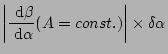
For a seeing limited instrument, spectral resolution is limited by the geometrical image size of the entrance slit, rather than the diffraction of the grating.
 of the slit image for a certain wavelength in
the emergent light from the grating is
of the slit image for a certain wavelength in
the emergent light from the grating is
 |
|
 |
(28) |
|
![$\displaystyle \frac{\cos[\alpha_0]}{\cos\beta} \times \delta\alpha$](img150.png) |
(29) |
 |
|
 |
(30) |
|
![$\displaystyle \frac{2d\cos[\alpha_0] \delta\alpha}{m}$](img153.png) |
(31) |
 is the full width. Therefore spectral resolving
power becomes
is the full width. Therefore spectral resolving
power becomes
![$1/n\cos[\alpha_0]$](img160.png) for
for
 . As a consequence, we need
![$n\cos[\alpha_0]$](img162.png) times more
grooves for a seeing limited spectrometer to achieve the same spectral
resolving power as for a diffraction limited spectrometer.
times more
grooves for a seeing limited spectrometer to achieve the same spectral
resolving power as for a diffraction limited spectrometer.
consideration
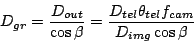
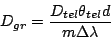
. With telescope aperture diameter , width of the
slit on the sky  , square root of system is
 .
.
and camera focal length
 .
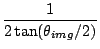
Thus, with width of the light direction conversing to the FPA
.
Thus, with width of the light direction conversing to the FPA
 , focal ratio of the spectrometer camera is
 |
 |
 |
(36) |
 |
(37) | ||
 |
(38) |
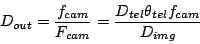
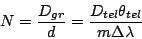
 diameter
of beam emerging from the grating is
diameter
of beam emerging from the grating is
 |
(39) |
is
 |
(41) |
 |
(44) |
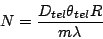
 , number of
grooves becomes
, number of
grooves becomes
 |
(45) |
is times that of the
diffraction limit of the telescope
 ,
,
 |
(46) |
 , with the image size
  of the slit being different. For this kind of requirements, design steps
are considered here.
of the slit being different. For this kind of requirements, design steps
are considered here.
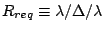 with being full width of
wavelenght for a spectral element. Moreover, groove interval of the
grating and diffraction order , difference of incident angle and
emergent angle
with being full width of
wavelenght for a spectral element. Moreover, groove interval of the
grating and diffraction order , difference of incident angle and
emergent angle  have to be defined. Also, pixel size of focal
plane array and required spatial resolution defines spectral element
and spatial magnification of the spectrometer
have to be defined. Also, pixel size of focal
plane array and required spatial resolution defines spectral element
and spatial magnification of the spectrometer  .
.
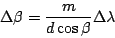
Incidecnt angle and emergent angle is calculated by
Equation 12. Because overall size of the spectrometer is
proportional to  , the solution with larger
  is
better than with larger
is
better than with larger  .
.
 |
(47) |
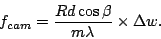
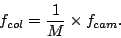
,
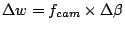 . Therefore, camera focal length has to be
 |
(48) |
 |
(49) |
![\begin{displaymath}
\Delta i = \frac{\cos[\alpha_0]}{\cos\beta} M \Delta s
\end{displaymath}](img193.png) |
(50) |
fixed.
times larger than that for a
diffraction limited instrument, system becomes
. With the slit width  , light disperses
with half angle of
, light disperses
with half angle of
 . Thus, beam width of the
incident light would be
. Thus, beam width of the
incident light would be
 |
|
 |
(51) |
|
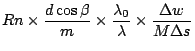 |
(52) |
 |
|
![$\displaystyle \frac{n\lambda_0 f_{col}}{\Delta s\cos[\alpha_0]}$](img200.png) |
(53) |
|
![$\displaystyle R n \times \frac{d}{m} \times \frac{\lambda_0}{\lambda} \times
\frac{\Delta w\cos\beta}{M\Delta s\cos[\alpha_0]}$](img201.png) |
(54) |
 |
|
![$\displaystyle \frac{n\lambda_0 f_{col}\cos\beta}{\Delta s\cos[\alpha_0]}$](img203.png) |
(55) |
|
![$\displaystyle R n \times \frac{d\cos\beta}{m} \times \frac{\lambda_0}{\lambda} \times
\frac{\Delta w\cos\beta}{M\Delta s\cos[\alpha_0]}$](img204.png) |
(56) |
From , number of grating grooves  becomes
![\begin{displaymath}
N = \frac{R n}{m} \times \frac{\lambda_0}{\lambda} \times
\frac{\Delta w\cos\beta}{M\Delta s\cos[\alpha_0]}
\end{displaymath}](img206.png) |
(57) |
being
![$M \Delta s
\cos[\alpha_0]/\cos\beta$](img207.png) , is
, is
 times more than
that for simple seeing limited spectrographs.
times more than
that for simple seeing limited spectrographs.
In total, we have to have the grating width
 times bigger than that of diffraction limited spectrographs.
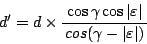
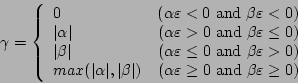
is not zero and or is not zero, some
of the light does not reach the mirror surface of a groove. When the
light has the angle  as in Figure 2 (a), can be
calculated as
as in Figure 2 (a), can be
calculated as
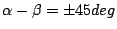
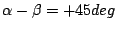
In a practical grating, we have to have
 and with
 for the central wavelength
  of the spectrometer,
 to maximize the slit function. Within
the requirements, is maximum when
to maximize the slit function. Within
the requirements, is maximum when
 .
.
When is defined as in Equation 60,
 and Equations 61 and
62 are identical to Equations 59 and
60.
and Equations 61 and
62 are identical to Equations 59 and
60.
th order is calculated
as follows.
First, defining the incident angle , emergent angle  to
the th order is calculated from Equation 10. With
to
the th order is calculated from Equation 10. With
th order is
There is a possibility of light splitting into
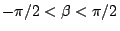 .
With
.
With  as minimum integer grater than
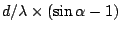 and
and  as maximum integer less than
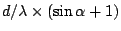 , total emergent intensity is
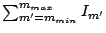 . Thus, Efficiency regarding the order
split is
. Thus, Efficiency regarding the order
split is
and when and are fixed. When taking spectra of a
wavelength band from  through
  , we have to
be careful not to allow the light from the next orders (
, we have to
be careful not to allow the light from the next orders ( ) into
the observed . For this, following condition has to be satisfied:
) into
the observed . For this, following condition has to be satisfied:
Table 1 shows the allowed for the NIR bands when
we want to take spectra of the whole band at once.
|
It turned out that:
and
have the same sign.
![\includegraphics[width=\textwidth]{J_orders.eps}](img241.png)
|
and from
From
 ,
,
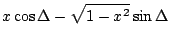
 .When we define
 and
and
 ,
,
 . Therefore, the second
condition becomes
. Therefore, the second
condition becomes
 , an equation of the same shape
comes out. This means that the two solutions
, an equation of the same shape
comes out. This means that the two solutions  of the second
order equation corresponds to
of the second
order equation corresponds to  and
and  .
.
Solutions of Equation 74 are
and can be derived as  .
.
Following is a perl script to calculate and .
#!/usr/bin/perl -w

# subroutines
# arcsin from man perlfunc
sub asin { atan2($_[0], sqrt(1 - $_[0] * $_[0])) }

# usage
$usage = << '_USAGE';
usage: alphabeta.pl delta(deg) m d lambda
  with delta=|alpha-beta|, m=diffraction order, lambda=wavelength
  prints out solutions for alpha(deg) and beta(deg)
_USAGE

# Main routine
# usage
if (@ARGV != 4) {
  print $usage;
  exit -1;
}

# get command line options
$delta = shift(@ARGV);
$m = shift(@ARGV);
$d = shift(@ARGV);
$lambda = shift(@ARGV);

# calculation
$pi = atan2(1,1)*4;
$cosd = cos($delta*$pi/180);		# cos(delta)
$sind = sin($delta*$pi/180);		# sin(delta)
$p = $m*$lambda/$d;			# m*lambda/d
$p1 = (-$p*(1+$cosd)+$sind*sqrt(2*(1+$cosd)-$p*$p))/2/(1+$cosd);
$p2 = (-$p*(1+$cosd)-$sind*sqrt(2*(1+$cosd)-$p*$p))/2/(1+$cosd);
$a1 = asin($p1)*180/$pi;		# solution in degrees
$a2 = asin($p2)*180/$pi;		# solution in degrees

# results
print "$a1 $a2\n";
and from
 coefficient in Equation 65
and .
coefficient in Equation 65
and .
This document was generated using the LaTeX2HTML translator Version 2K.1beta (1.52)
Copyright © 1993, 1994, 1995, 1996,
Nikos Drakos,
Computer Based Learning Unit, University of Leeds.
Copyright © 1997, 1998, 1999,
Ross Moore,
Mathematics Department, Macquarie University, Sydney.
The command line arguments were:
latex2html -dir html -mkdir -image_type png -local_icons -split 0 -up_url .. -up_title 'Parent directry' grating.tex
The translation was initiated by Daigo Tomono on 2002-02-04
![\includegraphics[scale=0.5]{geometry.eps}](img29.png)

![$\displaystyle r'_1 + r'_2 - [\{(n-\frac{N}{2})d - \delta\}(\sin \alpha + \sin \beta)
+ \delta \tan \varepsilon (\cos \alpha + \cos \beta)]$](img53.png)
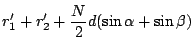
![$\displaystyle - nd(\sin \alpha + \sin \beta)
+ \delta \frac{1}{\cos \varepsilon}
(\sin[\alpha - \varepsilon] + \sin[\beta - \varepsilon])$](img56.png)
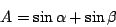
![\begin{displaymath}
E=
\frac{1}{\cos \varepsilon}
(\sin [\alpha - \varepsilon] + \sin [\beta - \varepsilon])
\end{displaymath}](img59.png)


![$\displaystyle \sum_{n=0}^{N}\int_{0}^{d'} \exp[i\phi(\delta, n)] d\delta$](img63.png)
![$\displaystyle \sum_{n=0}^{N} \exp[-ikndA] \times \int_{0}^{d'} \exp[ik\delta E] d\delta$](img64.png)
![$\displaystyle \frac{1-\exp[-ikNdA]}{1-\exp[-ikdA]}
\times \frac{1}{ikE}(\exp[ikd'E] - 1)$](img65.png)
![\includegraphics[scale=0.5]{shadow.eps}](img66.png)
![\includegraphics[scale=0.5]{shadow_right.eps}](img67.png)
![\begin{displaymath}
I(P_2) = \frac{1}{N^2}\frac{1-\cos[kNdA]}{1-\cos[kdA]}
\times \frac{2}{(kd'E)^2} (1-\cos[kd'E])
\end{displaymath}](img70.png)

![\begin{displaymath}
\beta = \arcsin[\frac{m\lambda}{d} - \sin\alpha]
\end{displaymath}](img73.png)

![\begin{displaymath}
\alpha \mbox{,} \beta =
\arcsin\left[
\frac{ \frac{m\lamb...
...os\Delta)-(\frac{m\lambda}{d})^2}}
{2(1+\cos\Delta)}
\right]
\end{displaymath}](img75.png)


![$\displaystyle \int_{A_1}^{A_2} \frac{1}{N^2}\frac{1-\cos[kNdA]}{1-\cos[kdA]}
\frac{2}{(kd'E)^2} (1-\cos[kd'E]) \cos\alpha \mbox{ d}A$](img114.png)
![$\displaystyle \cos\alpha_0 \int_{A'_1}^{A'_2} \frac{2(1-\cos[kNdA'])}{(kNdA')^2}
\mbox{ d}A'$](img124.png)
 .
.![\begin{displaymath}
\delta\alpha
\sim n\lambda_0/(2 D_{gr}\cos[\alpha_0]) \sim n \delta\alpha_{th}.
\end{displaymath}](img146.png)


![$\displaystyle \frac{m\lambda}{2d\cos[\alpha_0] \delta\alpha}$](img157.png)



![\begin{displaymath}
d' = d \times
\frac{\;\cos[\vert\varepsilon\vert - \gamma'] \cos \vert\varepsilon\vert\;}{cos\gamma'}
\end{displaymath}](img218.png)

![\begin{displaymath}
E_m =
\frac{1}{\cos \varepsilon}
(\sin[\alpha - \varepsilon] + \sin[\beta_m - \varepsilon] )
\end{displaymath}](img222.png)
![\begin{displaymath}
I_m = \frac{d'}{d} \frac{2}{(kd'E_m)^2} (1-\cos[kd'E_m])
\end{displaymath}](img223.png)
![\begin{displaymath}
\frac{I_m}{I_{total}} = \frac{
\frac{d'}{d} \frac{2}{(kd'E...
...}
\frac{d'}{d} \frac{2}{(kd'E_{m'})^2} (1-\cos[kd'E_{m'}])
}
\end{displaymath}](img230.png)

 )
)


 ,
,
 optimized for
 with
with
 .
.![\includegraphics[width=\textwidth]{J.eps}](img239.png)
![\includegraphics[width=\textwidth]{J_um.eps}](img240.png)
 and
and  . Squares and circles indicates the integer orders
which angles light of
. Squares and circles indicates the integer orders
which angles light of  actually emitted. For the
 ,
,
 ,
,
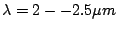
![\includegraphics[width=\textwidth]{Orders.eps}](img242.png)
 for the K-band grating.
  .
.![\includegraphics[width=\textwidth]{Delta.eps}](img243.png)
 ,
, ![\includegraphics[width=\textwidth]{d.eps}](img244.png)

![$\displaystyle \sin[\alpha - \Delta]$](img251.png)




![\begin{displaymath}
0 = x^2[(1+\cos\Delta)^2+\sin^2\Delta] - 2p(1+\cos\Delta)x +
p^2-\sin^2\Delta
\end{displaymath}](img258.png)
